
Description
How the Handle-O-Meter Works
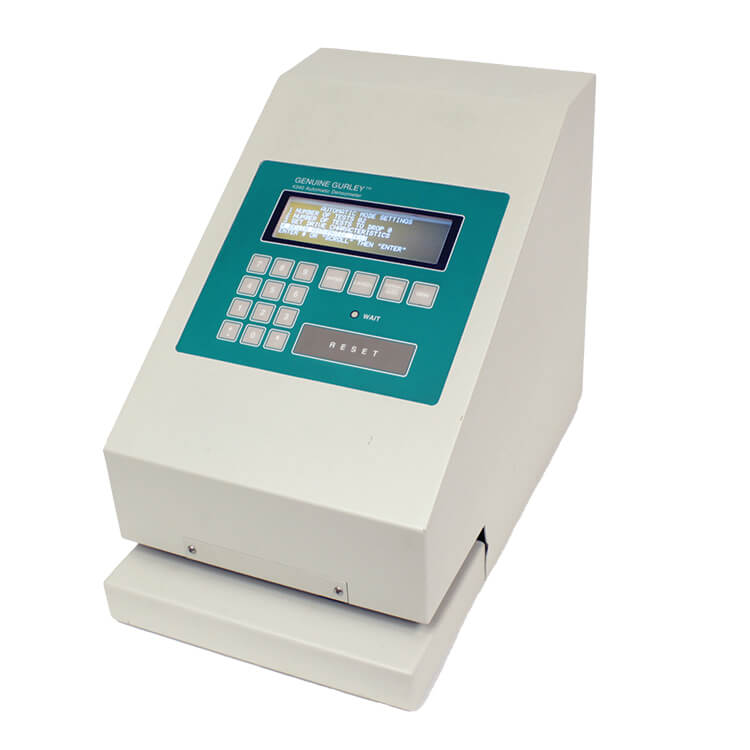
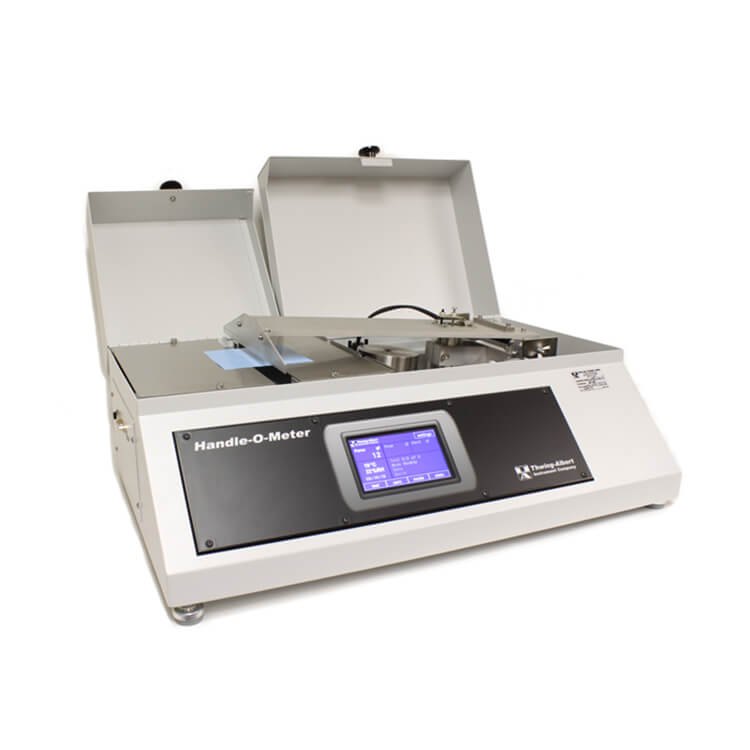
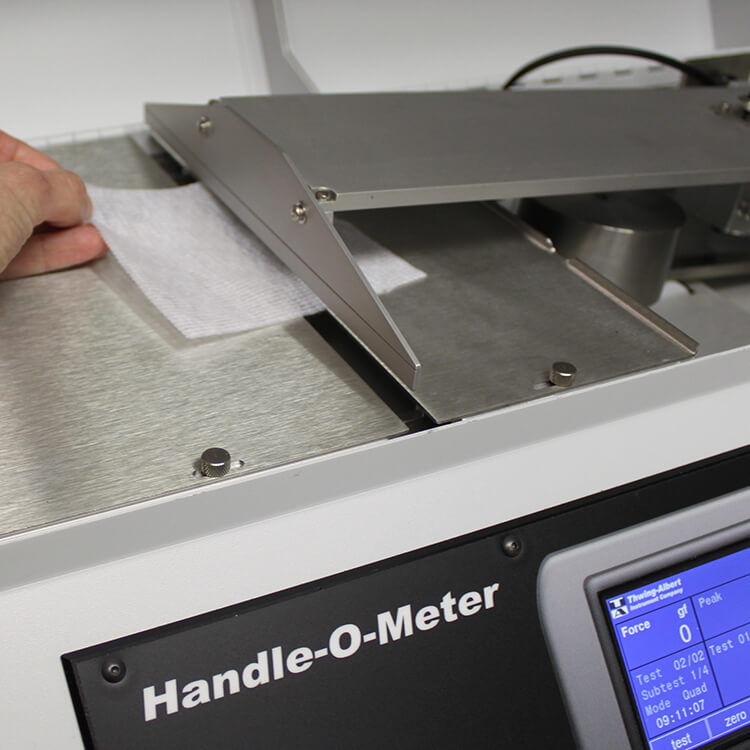
The Handle-O-Meter quantifies “handle” — the combined resistance a material exerts due to its stiffness and surface texture. To run a test, place the sample over the slot that extends across the instrument platform and press test. A penetrator beam pivots on a cam, engages the sample, and forces it into the slot. An LVDT in conjunction with a torsion bar measures the resistance encountered by the penetrator blade as it moves through the slot.
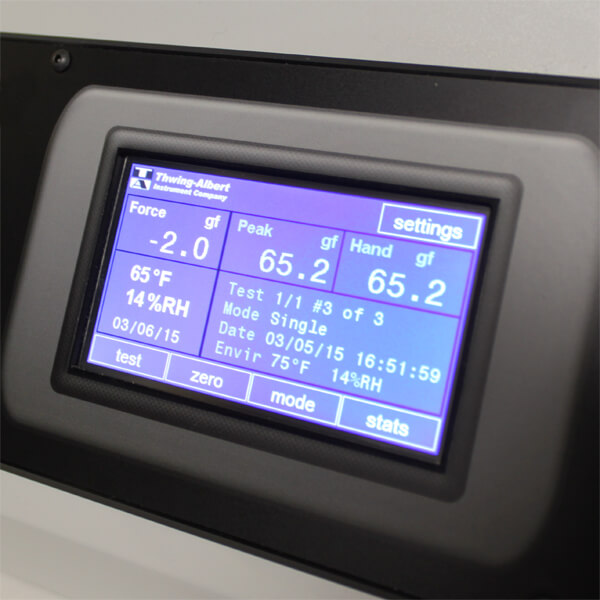
Two forces contribute to the reading: stiff materials resist the downward motion of the beam, while rough or high-friction surfaces create drag as the sample is pulled over the slot edge. The combined resistance is reported as a single value on the touch screen display. This test method has been shown to correlate well with actual material performance in production processes and finished product performance — making it a reliable alternative to subjective sensory panels.
Technical Specifications
| Specification | Detail |
|---|---|
| Model / Part Number | Handle-O-Meter / 211-2005 |
| Measurement Range — Standard Unit | 0–100 grams |
| Measurement Range — Heavy Duty Unit | 0–1,000 grams |
| Measurement Resolution — 100g Beam | 0.1 gram |
| Measurement Resolution — 1,000g Beam | 1 gram |
| Slot Opening Options | 5 mm, 10 mm, 20 mm, 1/4 in, 3/8 in |
| Display | 4″ × 2.25″ Touch Screen |
| Connectivity | USB and Serial Port |
| Power — Standard | 115 V ±10%, 60 Hz |
| Power — Optional | 220 V ±10%, 50 Hz |
| Dimensions (D × W × H) | 368 mm × 587 mm × 229 mm (14.5″ × 23 1/8″ × 9″) |
| Net Weight | 22.2 kg (49 lb) |
| Gross Weight | 24.5 kg (54 lb) |
| Test Modes | Single, Double, Quadruple (with automatic averaging) |
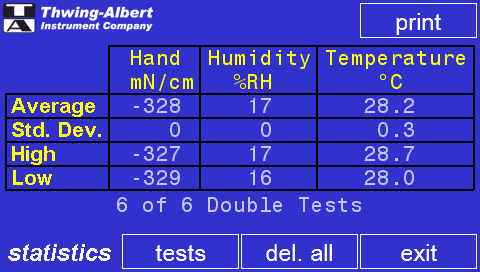
| Statistical Output | Average, Standard Deviation, High & Low values |
| Industry Standards | ASTM D2923, ASTM D6828-02, TAPPI T498, INDA IST 90.3, NWSP 090.3.R0 (15) |
Specifications subject to change without notice. The 211-2005 replaces the 211-2000 (legacy instrument).
Options & Accessories
Teflon Coated Plates — Recommended for use with plastic film to reduce static friction. The Handle-O-Meter should be configured with Teflon coated plates when testing plastic film materials.
MAP4 Materials Testing Software — Connects the Handle-O-Meter to a Windows-based PC. MAP4 comes equipped with preset standards and allows users to design, customize, and maximize testing procedures through simple menus. Key capabilities include:
- Data Acquisition — Automatically captures test results and statistics for softness/handle of materials.
- Data Management — Tag results with test conditions and sample identifiers, add or remove tests from group data, view multiple curves, and define viewable data ranges.
- Built-in Reporting — Generate reports for a full series of tests directly from the instrument or select specific results to include.
Applicable Industry Standards
| Standard | Overview |
|---|---|
| ASTM D2923 | Standard test method for measuring the rigidity of polyolefin film and sheeting using the blade/slot (Handle-O-Meter) method. |
| ASTM D6828-02 | Standard test method for measuring the stiffness of fabric using the blade/slot procedure, applicable to nonwovens and textile materials. |
| TAPPI T498 | Standard test method for measuring the softness of sanitary tissue using the Handle-O-Meter, essential for maintaining consistent quality in tissue production. |
| INDA IST 90.3 | Standard test method for evaluating the stiffness and hand feel of nonwoven fabrics, measuring the combined resistance of surface friction and flexural rigidity. Now globally harmonized as NWSP 090.3.R0. |
| NWSP 090.3.R0 (15) | Standard test method for evaluating the stiffness and hand feel of nonwoven fabrics using the Handle-O-Meter blade/slot method. The current globally harmonized version of INDA IST 90.3, jointly published by EDANA and INDA. |
Frequently Asked Questions
What is the Handle-O-Meter used for?
The Handle-O-Meter measures the softness and hand feel of sheeted materials by quantifying the combined resistance of flexibility and surface friction. It is used in quality control and R&D labs testing nonwovens, tissue, toweling, plastic film, and textiles.
What is the difference between the 100g and 1000g beam?
The 100g beam is for lighter, softer materials and offers a resolution of 0.1 gram. The 1000g beam is for stiffer or heavier-duty materials and has a resolution of 1 gram. Both beams are interchangeable and the instrument auto-detects which is installed, adjusting range and resolution automatically.
What slot widths are available?
The slot opening is adjustable to five settings: 5 mm, 10 mm, 20 mm, 1/4 inch, and 3/8 inch. This allows the instrument to accommodate samples of varying thicknesses.
Can the Handle-O-Meter test plastic film?
Yes. For plastic film testing, Teflon coated plates are recommended as an option to reduce static friction and ensure accurate results.
How many measurements can be run per test cycle?
Test modes can be set for single, double, or quadruple measurements. The instrument automatically calculates the average for double or quadruple test sets.
What statistical data does the Handle-O-Meter report?
The instrument reports average, standard deviation, and high and low readings across a series of tests directly on the touch screen display.
What software is compatible with the Handle-O-Meter?
The Handle-O-Meter is compatible with MAP4 Materials Testing Software, which enables Windows-based operation, preset standard test methods, data management, and built-in reporting.
How does the Handle-O-Meter replace a sensory panel?
Sensory panels rely on human touch to evaluate softness, which is subjective and time-consuming. The Handle-O-Meter produces a quantified, repeatable measurement that correlates with how a material performs in production and finished product use — eliminating panel variability and accelerating the evaluation process.