

Description
How the RL-CIT-A detects seal defects in cans
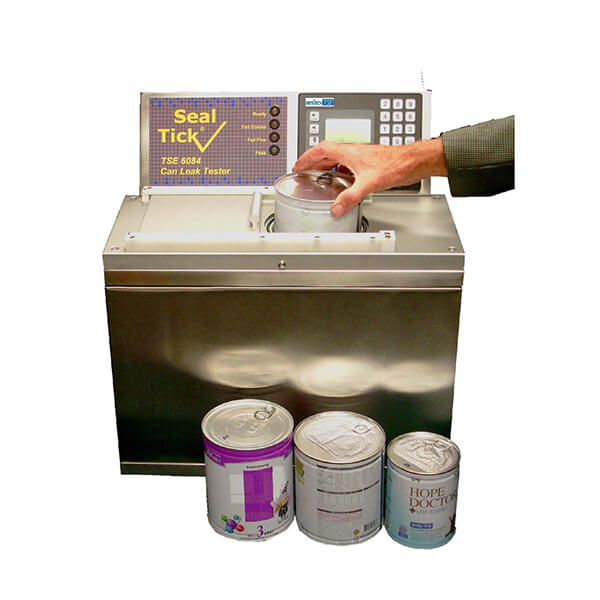
The RL-CIT-A uses a vacuum-decay method to identify seal defects in cylindrical cans — detecting breaches as small as 15 microns without inflating, pressurizing, or damaging the can. When the operator slides the lid closed, a fully automatic test sequence begins: the instrument draws a controlled vacuum in the close-fitting test chamber surrounding the can and monitors the vacuum for decay. Any breach in the can body, end seam, or lid — a micro-crack, an incomplete double seam, or a pinhole — causes a measurable pressure rise in the chamber. The instrument quantifies this leak rate with high resolution and compares it against the programmed pass/fail threshold.
Because the test chamber is sized to closely match the diameter and height of each can, the volume of air surrounding the can is minimized. This tight fit maximizes test sensitivity and protects the can from the forces generated by the vacuum — preserving can shape and ensuring that every can that passes can go straight back onto the packing line.
Can types and sizes tested
The RL-CIT-A is designed to test cylindrical cans across a wide range of materials and formats. Compatible can types include tin-plate metal cans, non-porous cardboard cans, and composite cans combining paper, plastic, and metal construction — common in products ranging from powdered infant formula and coffee to snack foods and industrial chemicals. The instrument accommodates different can diameters and heights through a system of interchangeable cylinder and disc inserts, each precision-machined to closely fit a specific can size. Testing any combination of can shapes within the largest supported size is possible with the appropriate insert set.
The instrument requires cans with a headspace of air or gas and generally dry contents — the same conditions present in the vast majority of sealed metal and composite can formats.
Industries and applications
Food and beverage canning: Incomplete double seams and micro-cracks in can bodies are among the leading causes of spoilage, contamination, and product liability in food manufacturing. A single defective seal allows oxygen and moisture ingress that degrades shelf life and can create conditions for microbial growth. The RL-CIT-A provides canning lines with a fast, objective, non-destructive method to verify seal integrity on every sampled can before it leaves the facility — covering formats including beverage cans, food tins, aerosol cans, and powdered product containers.
Coffee and specialty food packaging: Nitrogen-flushed coffee cans and vacuum-packed specialty food tins depend entirely on seal integrity to maintain flavor, aroma, and freshness. The RL-CIT-A’s high-resolution leak rate measurement is well-suited to detecting the fine seal defects that allow slow gas exchange — defects too small for visual inspection but significant enough to shorten shelf life measurably.
Pharmaceutical and nutraceutical cans: Powdered pharmaceuticals, nutritional supplements, and infant formula are commonly packed in composite or metal cans where seal integrity is critical to product stability. The RL-CIT-A’s quantitative output, 30-day onboard data logging, and Ethernet connectivity for record retrieval make it well-suited to quality programs that require traceable test records.
Industrial and chemical cans: Sealed metal containers for paints, coatings, adhesives, and specialty chemicals must maintain integrity during storage and transport. The RL-CIT-A’s stainless steel construction and production-floor durability make it practical for incoming QC inspection and end-of-line sampling in industrial packaging operations.
Why non-destructive can testing improves your QC program
Traditional can integrity verification methods — seam inspection by cross-sectioning, dye penetration, or water immersion — are destructive and time-consuming. Every unit tested is removed from inventory. On high-value products like specialty coffee, infant formula, or pharmaceutical powders, that scrap cost is significant at scale. The RL-CIT-A’s non-destructive vacuum-decay method means every can that passes the test returns to the production line intact and saleable. Combined with test cycles as short as 5 seconds, this makes high-frequency inline sampling economically practical in a way that destructive methods are not.
The instrument’s close-fitting chamber design also eliminates the subjectivity of operator-dependent visual seam inspection. Results are objective, repeatable, and quantitative — not dependent on inspector experience or lighting conditions.
Key features
- Vacuum-decay method detects seal defects as small as 15 microns — no water, dye, or tracer gas required
- Simple operation — sliding-lid closure initiates the fully automatic test sequence
- No special sample preparation needed
- Requires only mains power and compressed air (or optional external vacuum pump)
- Suitable for both quality laboratory use and inline production floor QC
- Tested cans return to the production line undamaged
- Test cycles from 5 to 15 seconds for most standard can sizes
- Pass, Fine Fail, and Coarse Fail lamp display plus quantitative backlit readout
- Close-fitting interchangeable cylinder and disc inserts maximize sensitivity and protect can shape
- Tests any combination of can shapes within the largest supported can size (inserts required)
- 20 nameable, user-programmable test methods optimized for different can sizes and products
- Test parameters stored under password protection
- 30 days of onboard data logging, one file per day, with Ethernet connection for periodic upload, mandatory record keeping, and trend identification
- Online monitoring via web browser over Ethernet
- Keypad control for setting and adjusting test times and parameters
- Recall of most recent test data to review test parameters
- Calibration menus for pressure verification
- High-resolution internal leak rate measurement via compressed air vacuum generation
- Stainless steel construction suitable for food, pharmaceutical, and production environments
Services and warranty
- Requires only mains power and compressed air
- 12-month warranty on parts and labor
Options
- External vacuum pump for air-free or compressed-air-restricted environments
- Power input: 115V or 230V AC
- Trolley-mounted version for testing larger packs or floor-level production access
- USB connection for log retrieval
Lab use vs. production line use
The RL-CIT-A is engineered to perform in both environments without compromise. In the quality lab, 20 programmable, nameable test methods and structured Ethernet-connected data logging support incoming material audits, new can format qualification, and formal seal integrity validation studies. On the production floor, single-step sliding-lid operation requires no specialized training — place the can, slide the lid, read the lamp. The optional trolley-mounted configuration allows the instrument to be positioned directly at the canning line for high-frequency in-process sampling without interrupting the production flow.
Also testing flexible packaging?
If your facility also runs pouches, bags, or MAP packs alongside canned products, see the Rycolab RL-PIT-A Flexible Package Integrity Tester — the flexible packaging counterpart to the RL-CIT-A, using the same vacuum method for non-destructive leak detection across a wide range of pouch and bag formats. Both instruments are available from Thwing-Albert as part of a complete package leak detection program.
Request a quote or ask a question
Thwing-Albert is the authorized North American distributor for Rycolab testing instruments. Whether you are establishing a new can integrity QC program, validating a new can format, or replacing an aging seam inspection process, our applications team can help you configure the RL-CIT-A for your specific can type and production environment. Contact us to request a quote, ask a technical question, or download the full product datasheet.