Upcoming Shows…
More Events
2025-2026 Events

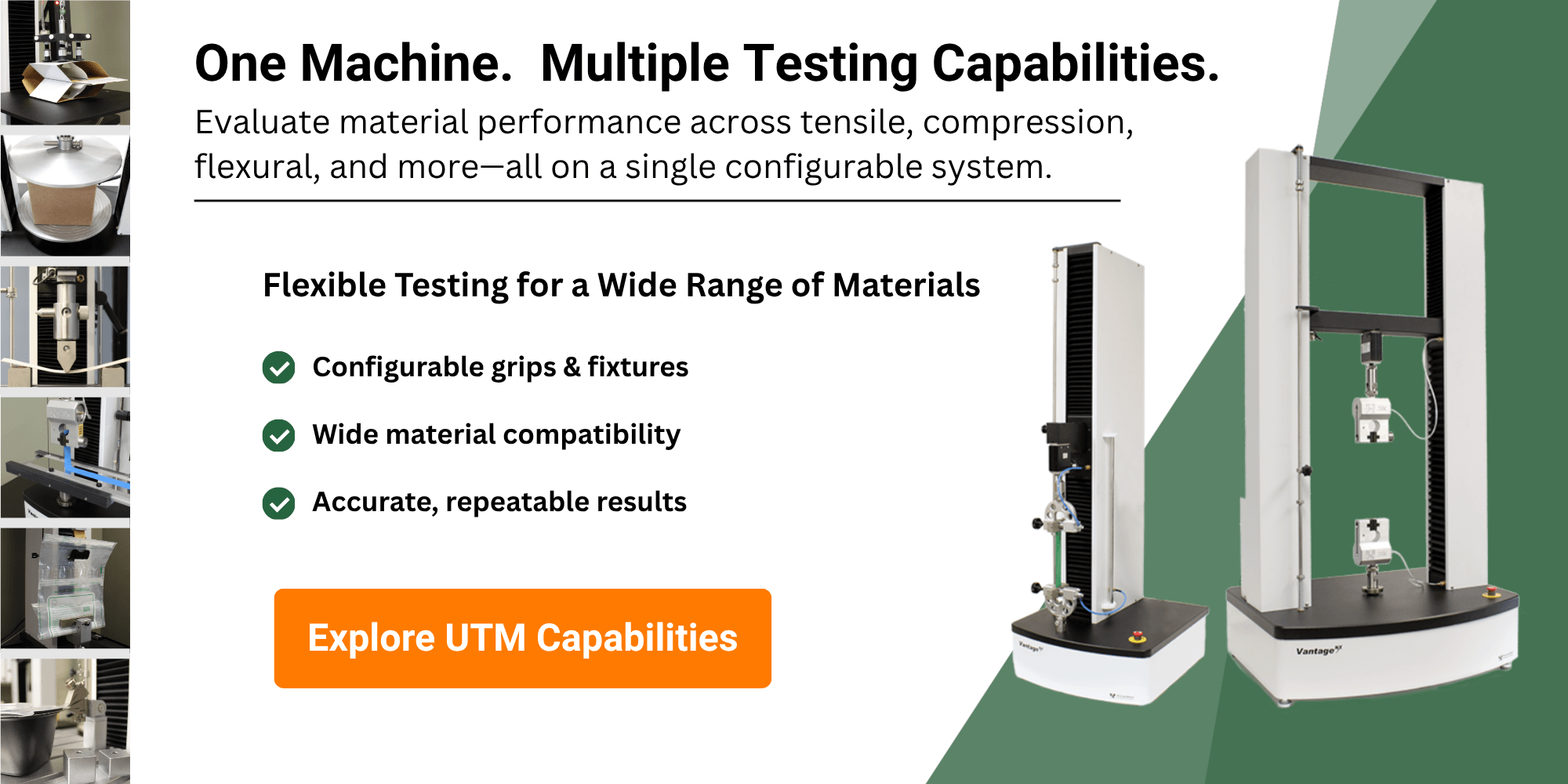
A Universal Testing Machine (UTM) measures how materials respond to forces such as tension, compression, bending, or shear, identifying when a sample deforms or fails. Widely used in manufacturing, research, and quality control labs, UTMs can test a variety of materials—including plastics, metals, rubber, films, textiles, adhesives, and packaging—by swapping grips, fixtures, and accessories to match the material, specimen, and test type. This flexibility allows a single system to perform a wide range of mechanical tests with consistent, repeatable results.
Grips and fixtures are essential for securely holding specimens and enabling specialized tests according to testing specifications. They also help ensure results are accurate, repeatable, and compliant with industry standards. While the tests listed below are common, UTMs can perform many additional tests depending on the configuration and materials being evaluated.
Universal Testing Machines can perform many different types of tests, and those listed below are some of the most common. As the name “universal” implies, UTMs can handle many additional tests with the right setup. Grips, fixtures, and accessories allow specialized tests to be performed depending on the material, specimen, and testing standard.
Tensile testing measures how a material behaves when it is pulled apart. The sample is stretched at a controlled rate until it deforms or breaks. This test helps determine key properties such as tensile strength, yield strength, elongation, and modulus of elasticity. Tensile testing is commonly performed on plastics, metals, rubber, films, and textiles.
Compression testing evaluates how materials respond to forces that push them together. The specimen is placed between two plates and compressed until deformation or failure occurs. This method is frequently used for foams, packaging materials, plastics, and structural components to determine compressive strength and deformation behavior.
Peel testing measures the strength of adhesive bonds between two materials. One material layer is pulled away from the other at a constant speed while the testing system records the required force. Peel testing is commonly used for laminated films, tapes, labels, and flexible packaging materials.
Tear testing determines how resistant a material is to the growth of an existing tear. A small notch is introduced into the sample and the machine measures the force required to continue tearing the material. This test is often used for films, textiles, rubber, and packaging materials.
Flexural testing evaluates how a material performs when subjected to bending forces. The sample is supported at two points while force is applied in the center. This method measures properties such as flexural strength and stiffness and is commonly used for plastics, composites, wood, and certain metals.
Shear testing measures a material’s ability to resist forces that cause surfaces to slide against each other. This test is useful for evaluating fasteners, bonded joints, and structural materials.
Bond testing evaluates the strength of adhesive joints between materials. By applying force to separate bonded surfaces, engineers can determine whether the adhesive provides sufficient strength for the intended application.
Stress relaxation and creep tests measure how materials deform over time under constant load or constant strain. These tests are especially important for polymers, elastomers, and rubber materials that experience long-term loading.
Universal testing machines are essential for evaluating the strength and durability of materials used in modern products. With the right configuration, a single machine can perform a wide range of standardized quality control tests.
These systems are also widely used for developing new materials, improving packaging performance, and evaluating emerging or sustainable materials to ensure they meet industry requirements.
For over a century, Thwing-Albert Instrument Company has provided precision materials testing equipment used by manufacturers and laboratories worldwide. Our universal testing systems are designed to deliver accurate and repeatable results across many different testing applications.
Conduct a wide range of material tests using our Universal Testing Machines, grips, and accessories. Contact us today to discuss your testing requirements and find the right solution for your application.