ASTM D645 is the standard test method for determining the thickness (caliper) of paper and paperboard. Thickness is a fundamental physical property in paper-based materials — it affects stiffness, bulk, printing performance, and how the material converts and performs in packaging applications. Because paper and paperboard compress under load, consistent measurement requires a deadweight instrument that applies a defined, repeatable pressure to the specimen.
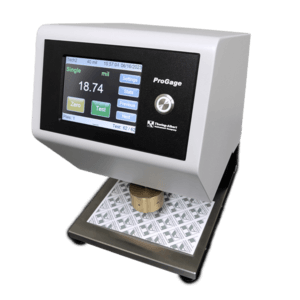
The ProGage Touch Thickness Tester is a precision deadweight micrometer designed to deliver accurate, repeatable thickness testing of paper, paperboard, and related materials. With interchangeable pressure feet and configurable test parameters, it can be set up to meet the measurement requirements of ASTM D645 and a broad range of other ASTM testing standards.
Why Choose the ProGage Touch to Meet ASTM D645?
With over 125 years of experience in materials testing, Thwing-Albert designs thickness testing instruments to meet the specific measurement requirements of established standards. The ProGage Touch uses a weighted lever design that reduces the pressure applied to the specimen — a critical feature when testing paper and paperboard, where the amount of applied pressure directly affects the thickness reading. Its configurable pressure foot, dwell time, and measurement speed settings allow operators to match the instrument to the requirements of ASTM D645, backed by our ISO 9001 certified commitment to quality.
Key Features for Paper and Paperboard Thickness Testing
- Standard paper pressure foot (0.630 in / 16 mm diameter) — custom feet available for specific method requirements
- Weighted lever design reduces pressure on compressible materials for more representative thickness measurements
- Configurable dwell time (0–20 seconds) and pressure foot speed to match method-specified conditions
- Rigid frame design for exceptional parallelism and zero stability
- Variable speed motor with up to 20 test cycles per minute for high-throughput QC environments
- Available in 40 mil, 100 mil, 200 mil, and 500 mil measuring range models
- Touchscreen interface with password-protected user profiles and up to 99 stored test setups
- Optional ProGage DAS2 Data Acquisition Software for automated data capture, statistics, and reporting
- Compatible with MAP4 Materials Testing Software for dwell-time analysis and advanced reporting
Common Applications for ASTM D645
ASTM D645 is widely used in the paper and paperboard industries for quality control and product acceptance testing. Common applications include incoming inspection of paper and board stock, caliper verification for printing and converting operations, and specification compliance testing for packaging materials. The standard is also referenced in the packaging and corrugated industries where consistent board caliper is critical to box performance and structural integrity.
Related Thickness Standards
The ProGage Touch can also be configured to meet related paper, board, and materials thickness testing standards, including:
- TAPPI T411 — Thickness of Paper, Paperboard, and Combined Board
- ISO 534 — Paper and Board: Determination of Thickness, Caliper, and Apparent Bulk Density
- DIN 53105 — Thickness Testing of Paper and Board
- ASTM D374 — Thickness of Solid Electrical Insulation
- ASTM D1777 — Thickness of Textile Materials
- ASTM D6988 — Thickness of Plastic Film and Sheeting
The standards listed above represent a selection of common thickness test methods — not a complete list. If you don’t see your standard, contact us and our team can help confirm the right instrument and pressure foot configuration for your method.
Related Resource
Not sure which thickness tester is right for your material or method? Read our blog post: How to choose the right instrument to measure thickness of compressible materials.
Frequently Asked Questions
What does ASTM D645 specify?
ASTM D645 specifies the test method for measuring the caliper (thickness) of paper and paperboard under a defined applied pressure using a deadweight micrometer. It establishes the equipment requirements, pressure foot configuration, and measurement procedure needed to produce results that are consistent, repeatable, and comparable across labs and sample lots.
Why does paper thickness testing require a deadweight micrometer?
Paper and paperboard compress under load, meaning the measured thickness changes depending on how much pressure is applied by the instrument. A deadweight micrometer applies a fixed, defined pressure to the specimen through the pressure foot and anvil, ensuring the same load is applied consistently from test to test. This is what makes results repeatable and comparable between instruments and labs.
What is the difference between ASTM D645, TAPPI T411, and ISO 534?
All three standards measure the caliper of paper and board using a deadweight micrometer, but they differ in the specified pressure foot diameter, applied load, and dwell time. Results from one method are not directly interchangeable with another without confirming the measurement conditions are equivalent. The correct standard to follow depends on your customer specification, your market, and any regulatory requirements that apply to your product.
Can the ProGage Touch store setups for multiple paper grades or standards?
Yes. The ProGage Touch allows operators to create and save up to 99 custom test setups with individual dwell time, measurement speed, opening distance, and return speed settings. This is useful for labs that test multiple paper grades, board weights, or need to switch between ASTM D645 and other thickness standards without manually reconfiguring the instrument each time.
Can the ProGage Touch be used for tissue or nonwoven thickness testing?
Yes — however, tissue and nonwoven materials require a different pressure foot and lower applied load than paper and paperboard, since those materials are much more compressible. The ProGage Touch includes standard tissue and nonwoven pressure feet alongside its paper foot, and the applied pressure can be set appropriately for each material type. Contact our team if you need to confirm the correct foot and configuration for your specific material and standard.